
Beyond Digital Averageness: The New Paradigm of Design and the 2026 Vision
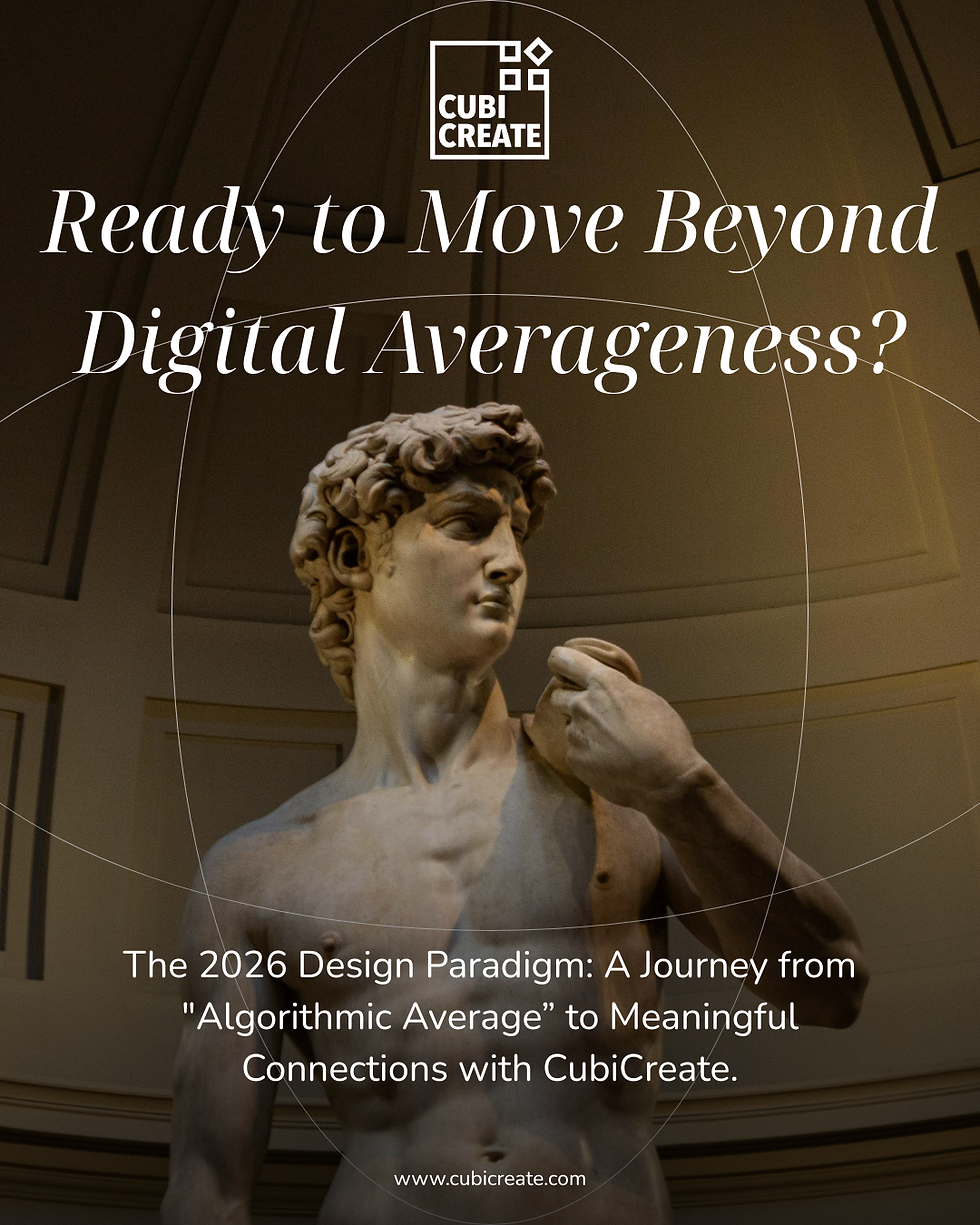
No matter where you go in the world today, finding yourself in a loop of "déjà vu" is no longer a coincidence. Whether it is the industrial design of a third-wave coffee shop in Berlin, the minimalist lobby of a boutique hotel in Tokyo, or the web interface of a tech startup in San Francisco—they all seem as if they have been passed through the same aesthetic filter by an invisible hand. In the modern world, rather than aesthetic "universality," we are faced with a profound "homogenization".
At this very point, the iF Design Trend Report 2026, one of the most prestigious guides in the design world, seals this situation with a striking term: "Age of Average". So, how did everything start to look so similar in this digital age, where we should be at the peak of innovation?. And more importantly, what does "Recoupling Design"—our exit ticket from this aesthetic prison—promise us?.
The Aesthetic Dictatorship of Algorithms: Why Does Everything Look the Same?

The "Age of Average" is not just a design preference; it is an inevitable output of a data-driven world. Today, when a designer draws a logo, an architect designs a facade, or a system design is developed, data and algorithms are often at the head of the decision-making mechanisms. The most engaged images on Instagram, the most "pinned" decoration ideas on Pinterest, and the templates marked as "system design" by Google drag designers into a safe harbor: "The most liked is the least risky".
As artificial intelligence and machine learning filter and present the "most probable" and "most familiar" to us, a massive visual homogeneity has emerged on a global scale. This situation has caused brands to sacrifice their own souls for the sake of fast readability and universal acceptance. However, as the iF Design Trend Report 2026 highlights, this situation has an expiration date. Human nature, by its very essence, gets bored after a while of excessive conformity and begins to search for "the different".
Recoupling Design: Re-establishing Lost Connections

The "big bang" promised by the report comes into play right here: Recoupling Design (Re-attachment Design). This concept refers to design breaking away from the mission of seeking only the "most optimized" and reconnecting with humans, culture, craft, and most importantly, the "beauty of the imperfect".
Rising as a rebellion against the cold and sterile perfection of the Age of Average, this trend shifts the focus of design from efficiency to meaning. Design is no longer just a tool used to solve a problem; it is the art of storytelling, creating a sense of belonging, and recreating the feeling of "reality" in a world dehumanized by the digital.
The Recoupling Design approach is built on three fundamental pillars:
A Bridge Between Local and Global: Contrary to algorithmic universality, it is the blending of local materials, traditional techniques, and region-specific stories with a modern design language.
Pre-Digital Nostalgia and Analog Touch: Instead of completely smoothed digital surfaces, designs that trigger the sense of touch and carry the traces of the human hand.
Intuition Against Algorithm: Positioning AI not as a decision-maker but as an assistant in the design process, allowing human intuition, aesthetic risk, and creative courage to make the final decision.
A New Era in Design: From Efficiency to Emotion

Looking towards 2026 and beyond, the key to success will no longer be "speed" or "optimization" because AI already performs these in their most perfect form. The new competitive arena of human-centric design will be the "capacity to connect". The iF Design Report leaves designers and brands with this critical question: If your design can be predicted by an algorithm, is it truly a design?.
Going beyond digital averageness is not just a visual change, but also a philosophical stance. This new paradigm promises a world that sees us as "humans" rather than "consumers," recognizing us not just as data points but as beings with emotions and cultural codes. The future will belong not to the smoothest, but to the one who tells the best story, establishes the deepest connection, and is brave enough not to fall into the comfortable trap of mediocrity. Now is the time to wake up from this aesthetic sleep and rediscover the wild, unpredictable, and fascinating creativity at the core of design.
The CubiCreate Perspective: Convenience Culture vs. Skillization

At CubiCreate, we believe that design is not just aesthetic "packaging," but the most powerful engineering discipline shaping the human experience. Today, the technology world is at a massive crossroads: on one side is the "Convenience Culture" that saves us from all kinds of trouble, and on the other is "Skillization," which aims to transform us into more competent individuals.
Here is an in-depth analysis of this critical conflict that will determine the user experience of the future, through the lens of CubiCreate.
Convenience Culture: The Golden Key to an Invisible Prison?
"Convenience Culture" is the greatest promise and, at the same time, the most insidious trap of modern design. AI, autonomous systems, and robotic technologies aim to reduce the "friction" of life to zero. One-click ordering, calendars organized by voice commands, playlists selected for us by algorithms... all serve a single purpose: to use time as efficiently as possible.
However, at CubiCreate, the question we ask is this: What are we losing while "winning" time?.
Frictionless services pasivize the user without them realizing it while reducing their cognitive load. The more effortless a process becomes, the less the individual's contribution to that process and, consequently, the less satisfaction they derive from it. Convenience Culture removes the user from being a "deciding actor" and turns them into a mere "approving consumer". This situation leads to a loss of motivation in the long run, the dulling of creativity, and a weakening of the individual's sense of control over their own life. If design remains solely "facilitation-oriented," it risks reducing the human to a mere spectator of their own life.
Skillization: A New Challenge in Design
So, how will we escape this sedative effect of convenience? The counter-trend we have taken into our strategic focus at CubiCreate comes into play here: Skillization.
Skillization defines well-being and happiness not just through "effortlessness," but through "competence" and "learning". The new task of design here is not to sit the user in a chair and offer them everything, but to encourage them to stand up and solve a problem. We call this "Active Design".
In active design, a product or interface does not just perform a function; it also helps the user develop a skill. For example:
Instead of a camera app that just "takes the best photo," an interface that teaches the user the logic of light and composition.
Instead of a navigation system that just "shows the shortest path," an experience that develops the user's sense of direction and city knowledge.
Instead of AI generating the creative output directly, offering tips and structural feedback that will develop the user's creative thinking muscles.
The CubiCreate Approach: Presenting the Problem as a "Gift"
In skill-acquisition-oriented design, we see the problem not as an obstacle, but as a "challenge". Human psychology secretes higher dopamine and satisfaction from results achieved through effort and overcoming an obstacle rather than results reached easily. The role of design here is to optimize this difficulty level according to the user's abilities (Flow Theory).
In the Skillization paradigm, the designer is not a janitor who clears all the stones in front of the user; they are a mentor who teaches the user how to overcome those stones or provides the necessary tools to overcome these obstacles. This approach makes lifelong learning a part of daily routines. Technology is no longer a "black box" that pasivizes us, but an "exercise partner" that develops us.
Future Design Strategy: A Hybrid Balance
The point we advocate at CubiCreate is not to abandon convenience completely. Of course, speed and effortlessness are a necessity in routine and chore-like tasks. However, in areas that create meaning and contribute to human development, we must consciously re-include "friction" into the design.
The successful brands of the future will not only be those that "save time" for the user, but those that show how they can use that saved time in a more qualified, more competent, and more satisfying way. Skillization is the restoration of the relationship between technology and humanity. Instead of delegating human creative power to AI, we should use AI as a catalyst that takes human creativity to the next level.
In conclusion; Convenience Culture "delivers" you to a point, while Skillization teaches you "how to travel". At CubiCreate, we are always in pursuit of designs that add value to the journey itself, turning the human from a passive recipient into an active creator. Because true innovation is not just making life easier, but making it more meaningful and livable.
Towards 2026: The Transformation of the Designer as a Strategist and Visionary

At CubiCreate, we are not just watching this great tectonic shift the design world is undergoing; we are leading the construction processes of the future at the very center of this transformation. From the point we have reached, we see that design has completely ceased to be just an aesthetic discipline of "producing objects". As we move towards 2026, the definition of design is evolving into a form of strategy, vision, and human-oriented curatorship. This evolution also forms the basis of CubiCreate's "System Design" approach.
The Designer's New Identity: From Practitioner to Curator
The designer of the past was the person who produced the most visual and functional solution in line with a "brief" given to them. However, in a world where algorithms, generative AI, and automation surround us, just "producing" is no longer enough. Algorithms can draw faster than us, create color palettes faster than us, and write code faster than us. At this point, from the CubiCreate perspective, the designer is reborn as a strategic curator.
In this new era, the designer takes on the role of a stronghold defending the depths of the human soul, the richness of cultural heritage, and the power of unexpected creativity against the smooth and soulless "averageness" offered by algorithms. At CubiCreate, we adopt an approach that triggers human skill and creative muscles against the passivity brought by technology. The designer no longer just determines the form of a product; they construct the strategy of how that product will contribute to the human quality of life, the learning process, and social bonds.
Not Speed, but Meaningful Impact: The Metric of the Future
The question "Which innovation is faster?" left over from the industrial age is now being replaced by a much deeper question: "Which combination creates a more meaningful impact?". At CubiCreate, we do not see innovation just as a technical novelty. For us, true innovation is the blending of the cold rationality of technology with the warm emotional needs of humans in the most accurate proportion.
In the world of the future, success will be measured not by the product that enters the market the fastest, but by the system that creates the deepest meaning in the user. Design is no longer a place to produce simple and temporary "patch" answers to complex problems. On the contrary, the true power of design comes from the ability to ask the right questions and to bring together communities, technologies, and ecosystems around these questions. This is exactly the point CubiCreate focuses on in its projects: not just providing solutions, but building a sustainable and collective future by going to the root of the problem.
Future: The Unifying Power of Design

In our 2026 vision, design is transforming from an individual action into a collective construction process. We construct human development (Human Enhancement) and our reconnection with nature (Next Nature) not as a conflict, but as an integration. To put it in CubiCreate language; we do not just design interfaces or buildings; we design life scenarios in which people will feel more competent, more conscious, and happier.
In conclusion, the new paradigm of design is to perfectly match technological possibilities with social realities and ecological necessities. In this process, the designer is a visionary strategist who brings together different disciplines like an orchestra conductor, keeps ethical values ahead of aesthetics, and is visionary enough not to fall into the comfortable trap of "averageness".
At CubiCreate, we will continue to be the advocate of "meaningful design" at every stage of this transformation. The future will be shaped not only by technology but by the vision with which we manage that technology for the benefit of humanity. Design is our compass on this journey, and the right questions are our greatest strength. We are ready to build a collective future with an understanding that is purified from mediocrity, original, and humancentered.
Follow us on Instagram: "click!"
Thank you


