
Marketing2030 Report: What Every Brand Leader Should Learn Before 2030
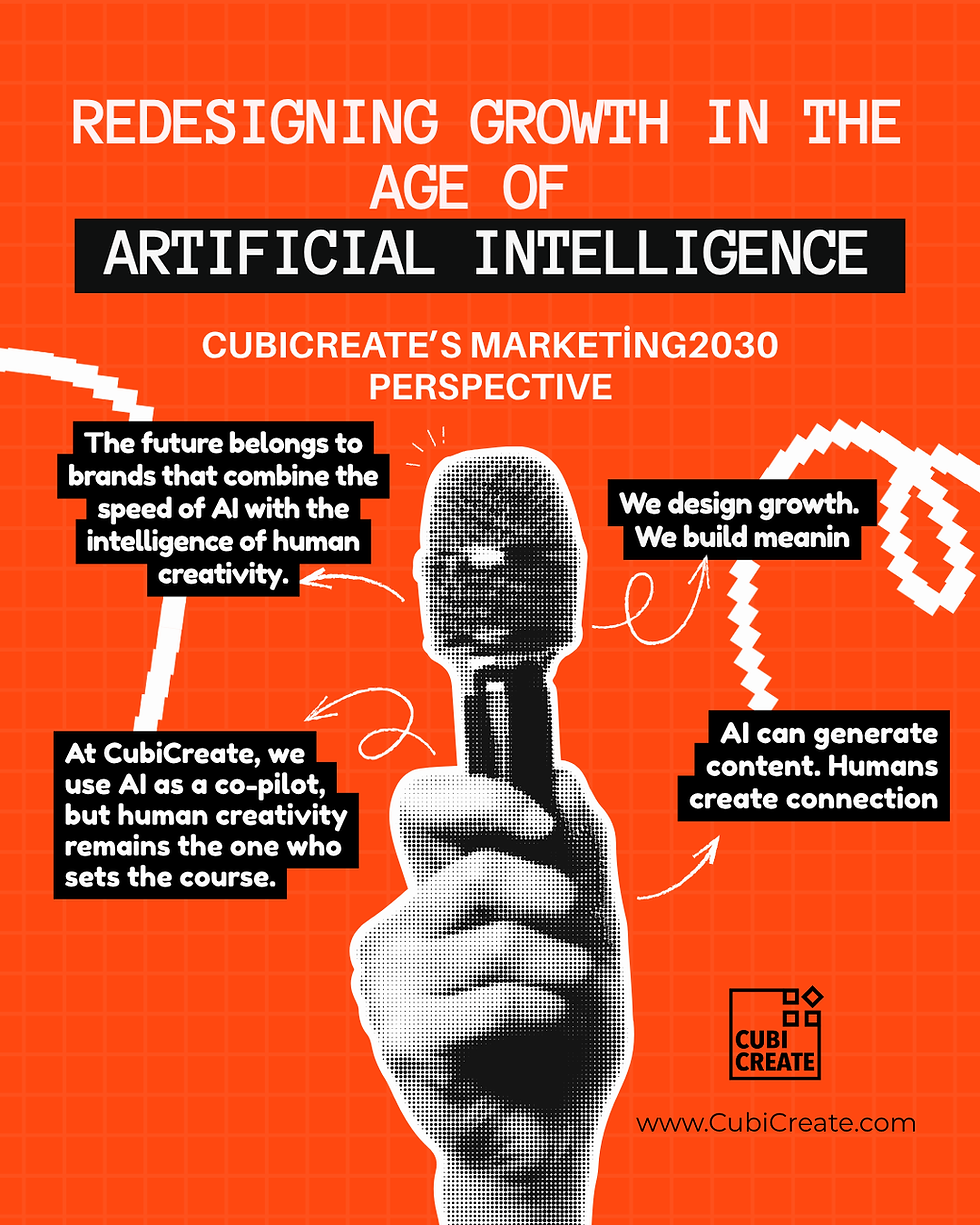
Marketing2030 Report:
What Every Brand Leader Should Learn Before 2030
Why Marketing Is Entering Its Biggest Transformation Since the Digital Revolution

For decades, businesses have measured growth through familiar indicators.
Revenue.
Market share.
Advertising performance.
Customer acquisition.
Sales.
These metrics continue to matter.
But the forces shaping business growth are changing faster than ever before.
Artificial intelligence is redefining productivity.
Consumer expectations continue to evolve.
Trust has become increasingly fragile.
Geopolitical uncertainty is influencing supply chains and investment decisions.
Digital experiences now shape customer expectations before the first conversation even begins.
These changes are not isolated trends.
They are reshaping the foundations of modern business.
This is precisely why the Marketing2030 initiative was created.
Developed by the Institute for Real Growth (IRG) in collaboration with Saïd Business School at the University of Oxford, Marketing2030 is not another report about marketing trends or digital transformation.
It asks a far more fundamental question.
What will enable businesses to achieve sustainable growth over the next decade?
The answer extends far beyond advertising, campaigns or communication.
According to the research, the future belongs to organisations capable of combining technology, human understanding, organisational alignment and long-term trust into one coherent growth system.
For business leaders, marketers and brand owners, this represents a significant shift in thinking.
Marketing is no longer simply about attracting customers.
It is becoming one of the central forces shaping how organisations create value.
Marketing Is No Longer a Department
One of the strongest ideas presented throughout the Marketing2030 research is that marketing can no longer remain isolated within a single department.
For many years, organisations viewed marketing as the team responsible for communication.
Advertising.
Social media.
Events.
Brand campaigns.
Public relations.
Sales support.
Yet customers have never experienced a company in departmental silos.
Customers experience one organisation.
The product shapes perception.
Customer service shapes perception.
Recruitment shapes perception.
Packaging shapes perception.
Digital platforms shape perception.
Invoices shape perception.
Even internal company culture eventually becomes visible to customers.
Every interaction contributes to what people believe about a brand.
Marketing2030 argues that future organisations must therefore adopt an organisation-wide marketing mindset.
Growth can no longer depend on one team attempting to communicate a promise that the rest of the organisation does not consistently deliver.
Instead, every department becomes responsible for strengthening customer trust.
This represents one of the most significant organisational changes discussed in the report.
Marketing is evolving from communication into coordination.
Artificial Intelligence Changes the Rules, Not the Goal
Artificial intelligence is often described as the defining technology of this generation.
The description is justified.
Within only a few years, AI has transformed content creation, software development, customer service, research, forecasting, design, analytics and business operations.
Tasks that once required days now require minutes.
Information that previously demanded extensive research is now instantly accessible.
Visual concepts can be generated almost immediately.
Automation continues expanding into every industry.
Naturally, organisations ask an important question.
How should we use artificial intelligence?
Marketing2030 approaches the question from a different perspective.
Rather than asking how AI changes marketing, the research asks how marketing should evolve in response to AI.
This distinction matters.
Technology changes tools.
It does not automatically change purpose.
The purpose of marketing remains remarkably consistent.
Understanding people.
Creating value.
Building trust.
Supporting sustainable business growth.
Artificial intelligence dramatically improves efficiency.
But efficiency alone rarely creates meaningful competitive advantage.
When every organisation has access to similar technologies, technology itself becomes less distinctive.
The competitive advantage moves elsewhere.
Towards judgement.
Towards leadership.
Towards interpretation.
Towards understanding people better than competitors do.
Marketing2030 therefore positions artificial intelligence not as the destination.
It is one element within a much larger transformation.
The Future Belongs to Human Centred Growth
Perhaps the most important conclusion emerging from the research is surprisingly simple.
The future will become more technological.
But successful organisations will become increasingly human.
At first glance, this appears contradictory.
It is not.
Technology removes friction.
People create meaning.
Artificial intelligence analyses patterns.
Humans interpret significance.
Automation accelerates production.
Leadership determines direction.
Algorithms personalise recommendations.
Brands create emotional connection.
These are fundamentally different capabilities.
Marketing2030 argues that organisations capable of combining both will outperform those relying exclusively on either technology or traditional thinking.
The report repeatedly returns to one central idea.
Growth in the next decade will depend less on producing more.
It will depend more on producing greater value for people.
That value increasingly emerges from experiences rather than transactions.
Relationships rather than campaigns.
Trust rather than visibility.
Long-term relevance rather than short-term optimisation.
Why Trust Is Becoming the New Currency
Trust appears throughout Marketing2030 as one of the most valuable strategic assets organisations can develop.
This is not accidental.
Consumers today possess unprecedented access to information.
Before contacting a supplier, they compare alternatives.
Before purchasing a product, they read reviews.
Before trusting a business, they investigate its behaviour.
Transparency has fundamentally changed decision-making.
This creates both opportunity and responsibility.
Companies capable of consistently delivering what they promise become significantly more resilient.
Those relying on exaggerated claims become increasingly vulnerable.
Trust therefore becomes more than communication.
It becomes operational.
Customers evaluate whether businesses behave consistently.
Investors evaluate leadership credibility.
Employees evaluate organisational purpose.
Partners evaluate reliability.
Trust influences every stakeholder.
Marketing2030 suggests organisations should stop viewing trust as a consequence of successful branding.
Instead, trust should become one of the foundations upon which branding itself is built.
Growth Is Becoming More Complex
Historically, growth often appeared relatively linear.
Increase production.
Expand distribution.
Launch advertising.
Acquire customers.
Scale operations.
Today’s environment is considerably more interconnected.
One geopolitical event can reshape supply chains.
One technological breakthrough can redefine an industry.
One customer experience can influence thousands of purchasing decisions through digital platforms.
Growth therefore requires greater adaptability than ever before.
Marketing2030 argues that future organisations must become more capable of learning continuously rather than simply executing established strategies.
This represents an important leadership challenge.
Future businesses will not necessarily succeed because they possess the most resources.
They will succeed because they respond more intelligently to constant change.

What This Means for Brand Leaders
For brand leaders, marketing directors, founders and business owners, Marketing2030 delivers a powerful message.
Brand building is no longer primarily about communication.
It is about organisational alignment.
Successful brands will increasingly emerge from organisations where product development, customer experience, technology, operations, design and leadership all reinforce the same strategic direction.
This changes the role of branding itself.
Brand identity becomes more than visual consistency.
Packaging becomes more than product protection.
Websites become more than digital brochures.
Customer experience becomes more than service.
Every touchpoint becomes evidence.
Evidence that either strengthens or weakens trust.
This represents one of the most significant opportunities for organisations preparing for the next decade.
Because while technologies continue evolving rapidly, one principle remains remarkably stable.
People continue choosing businesses they understand.
They continue trusting organisations behaving consistently.
And they continue building relationships with brands making their lives easier, clearer and more meaningful.
The Six Marketing2030 Principles That Will Redefine Brand Growth
If the first phase of Marketing2030 asked how businesses should prepare for the future, the second phase asks a far more important question.
What capabilities will separate successful organisations from everyone else by 2030?
The answer is not a new technology.
It is not a new marketing channel.
It is not another social media platform.
Instead, the research suggests that sustainable growth will depend on how organisations integrate technology, leadership, human understanding and organisational alignment into one coherent business system.
This represents a significant shift.
Marketing is no longer being redefined by the tools companies use.
It is being redefined by how organisations think.
Below are six of the most important principles emerging from the Marketing2030 research and why they matter for every brand preparing for the next decade.
1. Human Quotient Will Become More Valuable Than Artificial Intelligence
Artificial intelligence continues to evolve at extraordinary speed.
Every month brings more capable systems.
Better automation.
More sophisticated content generation.
More accurate forecasting.
More personalised customer experiences.
These developments naturally create one concern.
If machines become increasingly capable, where does human value remain?
Marketing2030 answers this through one of its most influential concepts.
Human Quotient.
Human Quotient represents the abilities technology cannot easily replicate.
Not because machines lack intelligence.
But because intelligence and understanding are fundamentally different.
Artificial intelligence processes information.
Human beings interpret meaning.
Technology recognises patterns.
People recognise context.
Algorithms optimise.
Humans empathise.
Systems predict behaviour.
Leaders understand motivation.
These capabilities become increasingly valuable precisely because technology becomes more capable.
As automation expands, empathy becomes more important.
As data increases, judgement becomes more important.
As content becomes abundant, originality becomes more valuable.
The future therefore does not reward businesses that replace people.
It rewards businesses that amplify uniquely human capabilities through technology.
For brand leaders, this creates an important responsibility.
Technology should improve efficiency.
People should improve relevance.
2. Trust Will Replace Attention as Marketing’s Most Valuable Asset
For many years, marketing focused primarily on attention.
How many impressions?
How many clicks?
How many views?
How much reach?
These measurements remain useful.
But Marketing2030 argues that attention alone is becoming increasingly fragile.
People can discover a brand within seconds.
They can also forget it within seconds.
Trust behaves differently.
Trust compounds.
Once earned, it reduces customer hesitation.
It strengthens loyalty.
It improves referrals.
It lowers acquisition costs.
It increases resilience during uncertainty.
Most importantly, trust cannot be purchased through advertising alone.
It must be experienced repeatedly.
Every customer interaction either strengthens or weakens it.
Packaging.
Customer support.
Product quality.
Leadership communication.
Website usability.
Sales conversations.
After sales service.
Brand consistency.
Trust grows through accumulated evidence.
Not isolated campaigns.
This represents one of the most important changes described by Marketing2030.
The objective is no longer simply attracting attention.
The objective is becoming worthy of attention.
3. Marketing Is Becoming Everyone’s Responsibility
Perhaps no conclusion within Marketing2030 challenges organisations more directly than this one.
Marketing no longer belongs exclusively to marketers.
Every department contributes to customer perception.
The engineering team influences customer experience.
Operations influence delivery reliability.
Finance influences transparency.
Recruitment influences employer reputation.
Leadership influences organisational credibility.
Design influences understanding.
Technology influences accessibility.
Customer service influences loyalty.
Marketing therefore becomes the language connecting every business function.
This idea fundamentally changes how organisations should think about branding.
A beautiful campaign cannot compensate for inconsistent customer experience.
Likewise, exceptional customer service cannot fully compensate for confusing communication.
Customers experience the organisation as one integrated system.
The strongest brands therefore become organisational brands.
Not communication brands.
This is perhaps one of Marketing2030’s most significant strategic insights.
Growth becomes impossible without alignment.
4. Long Term Value Will Outperform Short Term Optimisation
Modern marketing often rewards immediate performance.
Higher conversion rates.
Lower acquisition costs.
Faster growth.
Shorter sales cycles.
Quarterly targets.
These objectives remain commercially important.
However, Marketing2030 warns against allowing short term optimisation to replace long term value creation.
Businesses that continuously optimise for immediate results often weaken the foundations supporting sustainable growth.
Trust becomes transactional.
Brand equity declines.
Innovation slows.
Customer relationships become increasingly fragile.
Future ready organisations instead balance immediate performance with enduring relevance.
They continue measuring financial performance.
But they also invest in assets whose value compounds over time.
Customer trust.
Brand reputation.
Organisational learning.
Employee capability.
Design quality.
Customer experience.
Strong businesses understand that sustainable growth depends not only on today’s performance.
But tomorrow’s resilience.
5. Artificial Intelligence Changes Execution. Humans Define Direction.
Artificial intelligence dramatically changes how work gets done.
It accelerates research.
Generates concepts.
Automates repetitive tasks.
Supports decision making.
Improves forecasting.
Optimises workflows.
Yet Marketing2030 repeatedly suggests that leadership becomes even more important within highly automated environments.
Because execution becomes easier.
Direction becomes harder.
When everyone can generate visual concepts, who decides which concept deserves investment?
When everyone can produce content instantly, who determines which message truly matters?
When algorithms identify opportunities, who evaluates whether those opportunities align with organisational purpose?
Technology produces possibilities.
Leadership creates priorities.
Artificial intelligence reduces production costs.
Strategic thinking increases in value.
This distinction may become one of the defining competitive advantages of the coming decade.
Companies will not differentiate themselves by possessing more technology.
They will differentiate themselves by making better decisions.
6. Growth Will Depend on Understanding People Better Than Competitors Do
Throughout Marketing2030, one theme consistently returns.
Growth begins with people.
Not products.
Not technology.
Not advertising.
People.
Future organisations will increasingly compete through their understanding of human behaviour.
What creates confidence?
What reduces uncertainty?
Why do customers remain loyal?
What motivates recommendation?
How do people evaluate credibility?
These questions become more valuable as markets become increasingly competitive.
Artificial intelligence may reveal behavioural patterns.
Human understanding explains why those patterns exist.
This difference changes how organisations approach branding.
Instead of asking,
“How can we communicate more?”
Future leaders increasingly ask,
“How can we become more meaningful?”
Meaning creates memory.
Memory creates trust.
Trust creates growth.
What Does This Mean for Brand Leaders?
Taken together, these six principles describe a very different future from the one many organisations expected.
Technology remains essential.
Data becomes increasingly important.
Artificial intelligence transforms productivity.
Yet none of these become the ultimate competitive advantage.
The organisations most likely to succeed by 2030 will combine technological capability with deeply human leadership.
They will treat trust as infrastructure.
Marketing as organisational thinking.
Design as strategic investment.
Customer understanding as commercial intelligence.
Long term value as business resilience.
This perspective moves branding beyond aesthetics.
It positions branding as one of the most important growth systems inside the organisation.
And perhaps that is Marketing2030’s most valuable contribution.
It reminds us that despite extraordinary technological progress, business continues to depend upon remarkably human principles.
Understanding.
Trust.
Meaning.
Relationships.
Purpose.
The companies mastering these principles will not simply survive the next decade.
They will help define it.

The CubiCreate Perspective
What Marketing2030 Means for the Future of Branding, Packaging and Human Centered Design
Marketing2030 does not predict that artificial intelligence will replace marketers.
It predicts something far more significant.
It predicts that organisations capable of combining technology with human understanding will outperform those relying on technology alone.
At CubiCreate, we believe this conclusion extends beyond marketing.
It changes the role of branding itself.
For decades, many businesses viewed branding as the final stage of business development.
The company was established.
The product was developed.
Operations were organised.
Sales began.
Only then did branding enter the conversation.
Usually through a logo.
A website.
Packaging.
A catalogue.
Or a visual identity refresh.
Marketing2030 challenges that sequence.
If trust becomes one of the most valuable business assets, then branding cannot remain a finishing touch.
It becomes part of the business strategy itself.
Brand strategy is no longer simply about appearance.
It becomes a framework for reducing uncertainty.
Helping customers understand value faster.
Making expertise visible.
Building confidence before the first conversation.
This is exactly where we believe the future of branding is heading.
Design Is Becoming a Business System
One of the biggest misconceptions surrounding design is that it exists primarily to improve aesthetics.
Beautiful design certainly matters.
But beautiful design without strategic purpose rarely creates sustainable business growth.
Marketing2030 repeatedly emphasises that growth will increasingly depend on alignment across the organisation.
We believe design plays a central role in creating that alignment.
A strong visual identity is not simply a collection of colours, logos and typography.
It is a system.
A packaging system.
A communication system.
A recognition system.
A trust system.
When these systems work together, they reduce friction.
Customers understand the business more quickly.
Distributors evaluate products with greater confidence.
Sales teams communicate more consistently.
Employees develop stronger brand awareness.
Design therefore becomes operational.
Not decorative.
Packaging Is Becoming the First Business Conversation
For many manufacturers, packaging has traditionally been viewed as a production requirement.
Protect the product.
Meet regulations.
Display mandatory information.
Prepare it for transportation.
All of these remain essential.
But Packaging2030 and Marketing2030 point towards a broader reality.
Packaging increasingly represents the first physical experience customers have with a brand.
Before using the product…
Customers experience the packaging.
Before trusting product quality…
They evaluate perceived quality.
Before reading specifications…
They judge professionalism.
Packaging therefore performs multiple roles simultaneously.
It protects.
It explains.
It differentiates.
It builds trust.
It communicates positioning.
It reduces hesitation.
This transformation becomes even more important within European markets.
As sustainability regulations continue evolving and customer expectations become increasingly sophisticated, packaging will communicate far more than product information.
It will communicate whether a company appears prepared for the future.
Brand Identity Is Becoming Evidence
Marketing2030 repeatedly returns to the importance of trust.
We believe trust is built through evidence.
Not slogans.
Not promises.
Evidence.
Brand identity provides that evidence.
A consistent website demonstrates professionalism.
Thoughtfully designed packaging demonstrates care.
Clear presentations demonstrate confidence.
Well organised catalogues demonstrate capability.
Consistent communication demonstrates organisational maturity.
Every visual interaction answers questions buyers may never ask directly.
Can we trust this company?
Will working together feel organised?
Does this business understand international markets?
Is this supplier prepared for long term collaboration?
The strongest brand identities therefore reduce perceived risk.
And reducing perceived risk accelerates commercial decisions.
AI Will Democratise Production
Strategy Will Create Differentiation
One of the most significant consequences of artificial intelligence is the democratisation of production.
Professional looking visuals are becoming easier to create.
Content generation continues accelerating.
Photography can be enhanced automatically.
Presentations can be produced within minutes.
Websites can be generated rapidly.
Soon, producing competent marketing materials will no longer distinguish businesses.
Everyone will possess that capability.
The differentiator becomes something entirely different.
Direction.
Why does this business exist?
Which customer problem does it solve?
Why should people trust it?
What experience should customers remember?
How should every touchpoint reinforce the same strategic idea?
Artificial intelligence increases production capacity.
Brand strategy determines whether that production creates value.
This is why we believe strategic thinking becomes more valuable as technology becomes more accessible.
The easier it becomes to create content…
The more important it becomes to create meaning.
Human Centered Design Is Becoming a Competitive Advantage
Throughout Marketing2030, people remain at the centre of business transformation.
Not because technology lacks value.
But because technology only becomes valuable when it improves human experiences.
Human centered design begins with empathy.
Understanding motivations.
Reducing uncertainty.
Removing unnecessary complexity.
Helping people make better decisions.
This philosophy increasingly shapes every aspect of branding.
Packaging should become easier to understand.
Websites should become easier to navigate.
Visual systems should become easier to recognise.
Messages should become easier to trust.
Businesses often ask how artificial intelligence will change design.
Perhaps the better question is this.
How can design help people feel more confident in an increasingly automated world?
The organisations answering that question successfully will build stronger relationships than those focusing exclusively on efficiency.
European Markets Will Reward Clarity More Than Complexity
Across Germany, Italy, Bulgaria and wider European markets, customer expectations continue evolving.
People expect transparency.
Consistency.
Authenticity.
Accessibility.
Professionalism.
These expectations influence purchasing behaviour long before commercial conversations begin.
This is particularly important for manufacturers and B2B organisations.
Product quality often remains hidden until after the first interaction.
Brand perception becomes the visible indicator of operational excellence.
European buyers increasingly evaluate:
Packaging systems.
Corporate websites.
Digital communication.
Trade show materials.
Product catalogues.
Visual consistency.
The objective is not appearing larger than reality.
The objective is making genuine capability immediately visible.
Clarity therefore becomes a commercial advantage.
Not merely a communication preference.
Why Every Touchpoint Now Shapes Growth
One of Marketing2030’s strongest messages is that organisations grow through connected systems rather than isolated activities.
We believe branding operates according to the same principle.
Packaging cannot communicate one message while the website communicates another.
Sales presentations cannot promise simplicity while customer experiences create complexity.
Social media cannot describe innovation while visual identity appears outdated.
Every interaction either strengthens or weakens the same perception.
This means growth increasingly depends upon consistency.
Not repetition.
Consistency.
When customers repeatedly experience the same values across every touchpoint, trust develops naturally.
Trust reduces hesitation.
Reduced hesitation accelerates decisions.
Faster decisions support sustainable growth.
Our Prediction for 2030
After analysing Marketing2030 alongside the transformation already taking place across European markets, we believe successful brands will share eight defining characteristics.
They will use artificial intelligence to improve efficiency without allowing technology to replace strategic judgement.
They will treat trust as infrastructure rather than communication.
They will invest in design as a business system rather than a visual expense.
They will develop stronger understanding of human behaviour than their competitors.
They will build emotional relevance alongside operational excellence.
They will create consistent experiences across every customer touchpoint.
They will think long term while executing efficiently in the short term.
Most importantly…
They will remain unmistakably human.
Technology will continue evolving.
Human expectations will continue evolving.
But people will still choose businesses they understand.
They will still recommend companies they trust.
They will still remember brands making them feel confident.
Technology changes behaviour.
Human psychology changes remarkably slowly.
The organisations recognising this distinction will define the next decade.
Final Thoughts
Marketing2030 is not simply a report about marketing.
It is a report about organisational growth.
It reminds us that artificial intelligence will transform how businesses operate.
But it also reminds us that sustainable growth has never depended upon technology alone.
Growth depends upon people.
Their expectations.
Their decisions.
Their trust.
Their experiences.
Their confidence.
At CubiCreate, we see artificial intelligence as an extraordinary accelerator.
But acceleration without direction rarely creates meaningful progress.
That is why our work begins before colours, packaging structures or visual identities.
It begins with understanding.
Understanding the business.
Understanding the market.
Understanding the people the brand hopes to serve.
Only then do we design systems that transform expertise into trust, products into experiences and businesses into brands that people genuinely remember.
Because the strongest brands of 2030 will not simply be powered by artificial intelligence.
They will be guided by human intelligence.
And that, perhaps, is the most important lesson Marketing2030 offers every business leader preparing for the future.
About CubiCreate
CubiCreate is a strategic branding and packaging design agency helping manufacturers and B2B companies become more visible, more trusted and more competitive across European markets.
We combine brand strategy, visual identity, packaging design and AI assisted creative workflows with one principle at the centre of every project.
Make Your Quality Visible.


